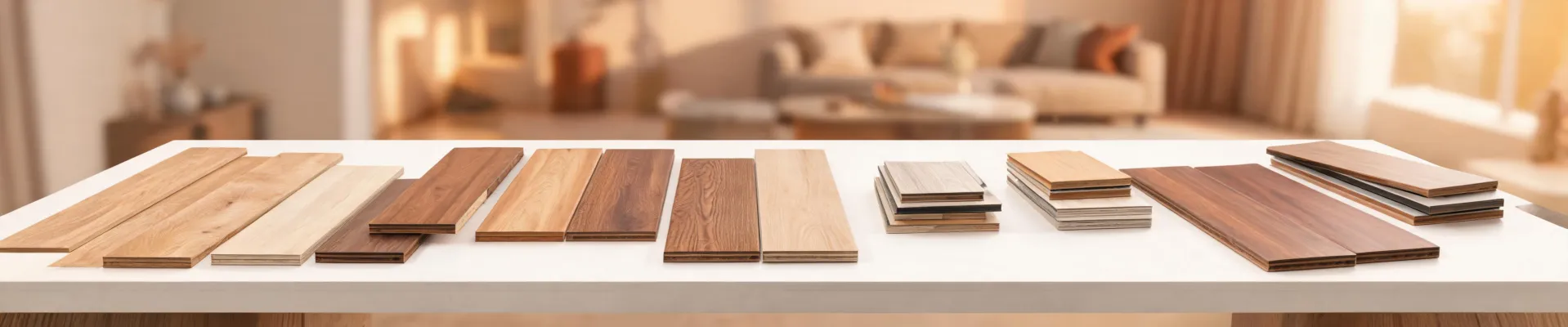
I handle quality and brand compliance for a building materials distributor. Roughly 200-plus SKUs a year pass through my desk before they ever reach a customer—flooring, tile adhesives, coatings, underlayment, the whole stack. In 2024, I rejected about 18% of first deliveries because what showed up on the pallet didn't match the spec sheet that was supposed to describe it.
So when someone asks me “should we go with Shaw flooring, or set up our own private label tile adhesive, or spec a custom coating?” I don't answer right away. Those are three different questions wearing the same coat. The right route depends almost entirely on what's actually driving your project.
Here's how I break it down. Three scenarios cover most of what I see:
- Scenario A: You have a hard deadline and need product that already exists.
- Scenario B: You're building a channel brand and want your name on the box.
- Scenario C: You need to control the formulation or the spec itself.
Sounds simple. It isn't—mostly because buyers sit in one scenario while shopping like they're in another.
Scenario A: The Deadline Is Real and It's Close
If you're fitting out a project that hands over in six weeks, or you've got a distributor program launching on a fixed date, you are not shopping for the best product. You're shopping for certainty.
That's where an established brand like Shaw earns its margin. Shaw flooring—carpet, LVP, hardwood—sits in warehouses and dealer networks that already exist. You're not waiting on a factory to schedule a run. You're pulling from inventory that someone else already paid to hold.
Same logic applies to a tile adhesive catalog from an established supplier. The C1 and C2 classifications you see on the bag (that's the ISO 13007 performance grading—C for cementitious, 1 or 2 for the performance level) tell you what the product is designed to handle. A stocked catalog item that hits your spec is worth more than a perfect custom blend that ships in fourteen weeks when you needed it in four.
Here's the thing people miss about rush decisions: the premium you pay for guaranteed delivery isn't really paying for speed. It's paying for the removal of doubt. An uncertain cheap option is more expensive than a guaranteed one once you factor in what a missed handover actually costs.
Back in March 2024, we paid about $400 extra to air-freight a pallet of adhesive a contractor needed for a Monday install. The alternative was missing a handover worth roughly $15,000 in penalties. That's a no-brainer once you do the math.
One more thing about going with a brand like Shaw: pay attention to the warranty language around maintenance. Shaw's carpet warranties, for example, are tied to how the carpet is cleaned. Use the wrong carpet cleaner (or the wrong method) and you can end up in a dispute that has nothing to do with whether the carpet was defective. I've watched a customer lose a warranty claim over exactly that.
I learned to check this the hard way. I assumed a “carpet-safe cleaner” on the label meant any cleaner labeled for carpets. Didn't verify. Turned out each brand maintains its own approved list, and generic shampoo doesn't automatically make the cut. Now I pull the warranty doc before we place the order, not after.
Scenario B: You're Building Your Own Channel Brand
Now flip it. If your goal is to build a brand that distributors and contractors ask for by name, you don't want to be the guy selling the same Shaw box everyone else sells. You want your name on it.
That's private label territory. Tile adhesive private label is a pretty mature play at this point—plenty of factories will run your branding on an existing formulation. You get to set your pricing, control your margin, and build a catalog that's actually yours.
The trade-off: you're renting the formulation, not owning it. The supplier can change it, stop making it, or sell the same product to your competitor under a different label. If your entire business is one SKU, that's a red flag.
We didn't have a formal approval process for private label packaging when we started. That cost us. One run went out with our logo on a bag that still carried the factory's internal model code in small print. Contractors noticed. That's the kind of detail that makes you look like an amateur, and honestly, we were.
The third time a packaging detail slipped through, I finally built a sign-off sheet: formulation locked, packaging proof approved, warranty language reviewed, and a physical sample box in hand before we commit to a run. Should have done it after the first time.
On cost: private label adhesive pricing usually lands somewhere around 5–12% below the equivalent branded item at volume (based on quotes we collected in early 2025; check current numbers, this moves). That gap is real, but it's smaller than people assume. The bigger win is usually control over your own catalog and pricing, not the unit cost.
Scenario C: You Need to Own the Spec
This is where protective coating OEM vs private label actually matters, and where a lot of buyers get the two confused.
Quick definitions, because the terms get used loosely:
- Private label (i.e., the factory's existing formula, your brand) — you choose from what already exists.
- OEM (original equipment manufacturer, meaning the product is built to your specification) — you define the formula, the performance targets, and often the test data behind them.
For a protective coating, that distinction drives everything. A private label floor coating is basically the factory's product in a different can. An OEM coating is built around your stated requirements—say, a specific VOC ceiling (VOC = volatile organic compounds; coating limits are typically set under EPA's AIM rules and individual state regulations), a defined cure window, or a slip rating you have to hit.
OEM costs more upfront—tooling, testing, minimum runs—and takes longer. That's just the reality. The question is whether the differentiation pays for itself.
Even after we signed off on an OEM coating run last year, I kept second-guessing. What if the custom cure window didn't hold up in cold-weather installs? The six weeks between placing the order and getting the first production batch were stressful. I didn't relax until we pulled samples from three different production dates and the test results held steady.
They did, mostly. If I remember correctly, one batch ran slightly outside the target viscosity range—but still inside the tolerance we'd written into the spec. Which is exactly why you write tolerances into the spec in the first place.
How to Tell Which Scenario You're In
Forget the product for a second and answer these:
- Is there a fixed date you can't move? If yes, you're in Scenario A. Buy what's in stock, pay for the certainty, and don't overthink the spec sheet on a deadline.
- Is your goal your own branded catalog? Then you're in Scenario B. Private label.
- Do you need performance or compliance that no stocked catalog item gives you? Then you're in Scenario C. OEM.
If you can't answer decisively, you're probably in Scenario A while pretending to be in B or C. I see that constantly—a buyer with a two-month deadline who wants to “explore custom formulation.” That's not a strategy. That's a way to miss the deadline and pay twice.
Bottom line: the brand you buy and the sourcing route you pick should be a consequence of your constraints, not the other way around. Meet the deadline first. Build the brand second. Customize the spec when—and only when—the differentiation pays for itself.
If you're stuck between two scenarios, pick the one with the harder deadline. That usually settles the argument.