-
What should I check first on a commercial flooring manufacturer?
-
How do I verify a lead time instead of guessing?
-
Where does engineered wood flooring fit in commercial projects?
-
Does the underlayment manufacturer actually matter?
-
Which certifications should I actually require?
-
What do buyers forget to ask?
-
How has commercial flooring sourcing changed since 2020?
-
Anything specific to rush orders?
I coordinate commercial flooring supply for a building materials distributor. Over nine years I've handled 200+ rush orders — same-day turnarounds for general contractors, facility managers, and a handful of clients who called on a Friday afternoon with a Monday install date.
Most of the questions I get aren't about color or finish. They're about whether a manufacturer will actually deliver what the spec sheet promises. Here's what buyers and specifiers ask me most, roughly in the order I'd want to know it:
- What should I check first on a manufacturer?
- How do I verify a lead time instead of guessing?
- Where does engineered wood actually fit?
- Does the underlayment manufacturer matter?
- Which certifications do I really need?
- What do buyers forget to ask?
- How has commercial flooring sourcing changed since 2020?
- Anything specific to rush orders?
What should I check first on a commercial flooring manufacturer?
Before the catalog, before the pricing: will they put the lead time and the warranty terms in writing, on the quote, before you issue the PO?
Three times now I've watched a vendor quote "2–4 weeks" and then explain, three weeks in, that the clock started when the mill ran the batch — not when they received the order. That distinction is worth real money on a commercial job with a liquidated damages clause.
The written version forces clarity. It also tells you how a company handles accountability. A vendor who gets cagey about putting a ship date in a document is telling you something (and it's usually something you'd rather learn now than on installation day).
How do I verify a lead time instead of guessing?
Ask for a ship date, not a lead time range. Those are different questions and vendors answer them differently.
In March 2024, a client called 36 hours before a tenant improvement deadline needing roughly 4,000 sq ft of LVP. Normal turnaround was 10 business days. We found a regional supplier with stock, paid about $2,900 in rush and expedited freight premiums on top of the base order, and delivered with six hours to spare. The client's alternative was a $40,000 delay penalty in the GC's contract.
What most people don't realize is that published lead times often include buffer a manufacturer uses to manage its production queue. It's not necessarily how long your order takes — it's how long their worst-case order takes. That's a fairly important difference when you're working backwards from an install date.
Where does engineered wood flooring fit in commercial projects?
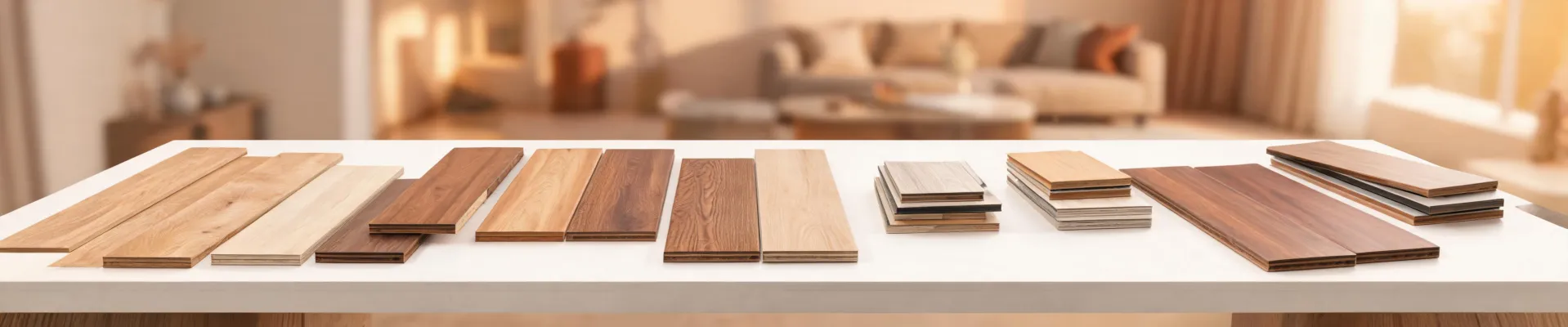
Engineered wood is a reasonable middle ground between solid hardwood and resilient options, particularly where dimensional stability matters. But "engineered" covers a wide range of products. Wear layer thickness, core construction (HDF vs. plywood vs. composite), and whether the plank is glued-down or floating change the performance far more than the brand name does.
When we spec Shaw engineered wood flooring for a commercial space, the first conversation isn't about species or finish — it's about the subfloor. If the slab reads high on moisture, the whole conversation changes. ASTM F2170 (in-situ relative humidity probes) or ASTM F1869 (calcium chloride) results come before the sample board, not after.
And no, engineered wood isn't the right answer for every room. Break rooms, entry vestibules, and anything with regular standing water need a different product. Anyone who tells you one floor works everywhere hasn't walked a job site.
Does the underlayment manufacturer actually matter?
Yes, and this one surprises people. Flooring, adhesive, and underlayment are a system. Pair a manufacturer's plank with a third-party cushion and you may void the flooring's wear warranty — even if the cushion itself is perfectly good. The two products were never tested together.
So the questions to ask a floor underlayment manufacturer are narrower than they look: Does this specific underlayment have written compatibility with this specific flooring? Is there a tested assembly, or just a general claim?
We didn't have that question in our RFQ template for years. Cost us when a claim got denied over an unbranded cushion on a 6,000 sq ft job. That's when we added a compatibility line to every commercial RFQ — first page, not page nine.
Which certifications should I actually require?
Depends on the project, but these come up most often in commercial flooring sourcing:
- TSCA Title VI — the EPA formaldehyde emission standard for composite wood, with a compliance date of March 22, 2019. Companion to CARB ATCM Phase 2.
- FloorScore (administered by SCS Global Services) or compliance with CDPH Standard Method v1.2 for VOC emissions.
- ADA Standards for Accessible Design (2010) for transitions, thresholds, and height changes at doorways.
- EPD or HPD if the project is pursuing LEED v4.1 or has a healthy-materials spec section.
Verify current requirements at the source — standards get revised and project specs sometimes reference older editions. Don't take a certificate at face value either; check that the certificate number matches the specific product SKU, not just the manufacturer.
What do buyers forget to ask?
Two things, and they both cost money.
First: who actually owns the warranty? With private label and OEM programs, the brand on the box isn't always the manufacturer. If the label is a distributor's house brand and the distributor changes suppliers next year, your warranty claim may land somewhere unexpected. Get the warranty issuer named in the contract.
Second: what's the substitution policy? Dye lot variation, discontinued SKUs, and "closest available" swaps are routine in this industry. Ask up front what happens if the specified product is short, who approves the swap, and whether the pricing holds.
People assume higher price means better quality. It's closer to the reverse — manufacturers who can prove performance with data and documentation tend to charge more for it. The causation runs the other way, which means price is a fairly weak proxy for quality on its own.
How has commercial flooring sourcing changed since 2020?
Quite a bit, and it's worth saying plainly: what was best practice in 2020 may not apply in 2025.
Spec libraries went digital and searchable. EPDs and HPDs moved from "email us for a PDF" to downloadable in about four clicks. Real-time inventory visibility became a baseline expectation rather than a premium service. Installation documents now come with QR codes so the crew on site can pull the current version instead of the one printed eighteen months ago (not that anyone misses the printed binder).
What hasn't changed: moisture testing before installation, written terms before the PO, and system compatibility between flooring, adhesive, and underlayment. The fundamentals are the same. The execution around them is not. To be fair, the older process worked fine for a long time — but the margin for error has shrunk because everyone else got faster.
Anything specific to rush orders?
One thing, and I'll keep it short: get the deadline in writing, even from vendors you've trusted for years.
I skipped that step once because we'd worked with the supplier for a long time and it was "obviously" a Friday delivery. It wasn't. Their confirmation email said "week of." We caught it on Thursday, paid $1,100 for expedited freight on a partial shipment, and covered the remainder from another distributor's stock. We made the install. Barely.
Now every rush order gets a written confirmation with a date and a time, even if it's a two-line email. It takes thirty seconds and it has saved us at least twice since.