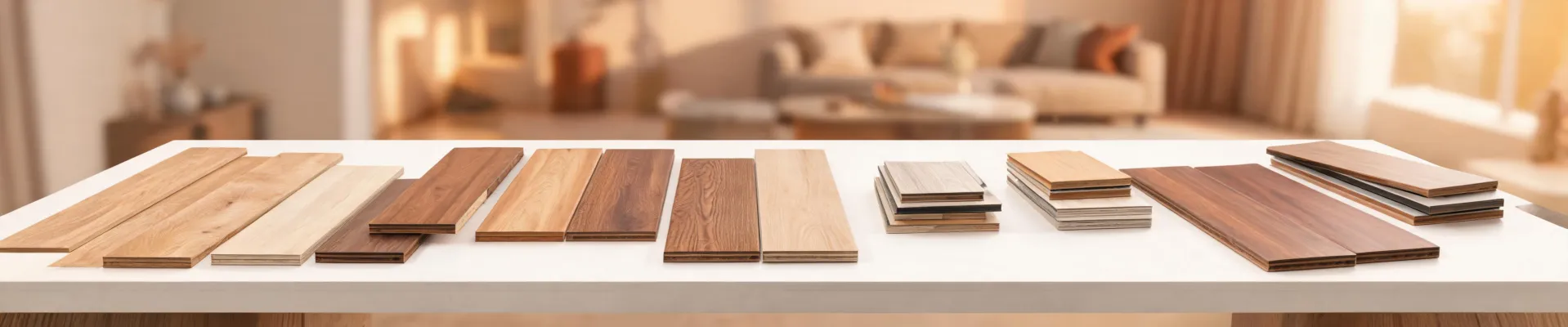
The sample was perfect. The project wasn't.
In early 2025, I approved two purchase orders for the same tenant build-out. The LVP flooring looked great in the sample. The construction sealant looked fine too. The quotes were below budget, and the delivery date matched our schedule. I was proud of myself.
Then the first carton arrived. The LVP was two shades darker than the sample. The sealant skinned over in 12 minutes instead of the 40 we planned for. The project went sideways fast.
I've been a procurement manager for 11 years, handling commercial flooring and building material orders for most of that time. I've personally made and documented six significant mistakes. Roughly $32,000 in wasted budget. Six too many. Now I maintain our team's supplier checklist. This is the story behind that checklist.
The mistake I kept making
Before 2022, I treated every purchasing decision as a pricing problem. I'd get three quotes, compare unit prices, add shipping, and pick the lowest total. That approach failed in the same way every time.
The problem wasn't the product category. It was the gap between what the sample showed and what the factory actually shipped. I didn't realize I was comparing the wrong thing.
What 'commercial flooring private label' actually means
Everything I'd read about private label said the same thing: you're getting the same product without the brand markup. In practice, I found the opposite. Private label can mean a product made to someone else's recipe, in a different factory, under a different QC standard.
In 2019, we ordered 2,300 square feet of commercial flooring private label. The sample was marked 'made in the same plant as our house brand.' It didn't tell us that the house brand had a separate QC process with tighter color tolerances. The delivered batch had 0.4mm gauge variation. We installed it on a Thursday; by Monday, three planks were lipping. Total loss: $11,000.
I assumed 'same as sample' meant the whole order would match. Didn't verify. Turned out the order ran on a different production line. That was the moment I decided to change how we vet suppliers. (Note to self: stop trusting 'same as' arguments.)
What to look for in a construction sealant supplier
The flooring got all the attention. The construction sealant supplier almost got a free pass. That's backwards. What to look for in a construction sealant supplier is not just a low price per tube. It's the cure profile, the storage life, the substrate compatibility, and the human being who answers when something fails.
In Q1 2022, we ordered a urethane sealant for a storefront. The supplier said it was equivalent to the approved sample. We approved it based on a one-page data sheet. On site, our installer used his normal technique. The sealant skinned over in 12 minutes instead of the 45 we expected. Three panels failed adhesion. That mistake cost $4,800 in material plus two days of labor. The general contractor stopped taking my calls for a week.
What a failed order actually costs
Those two stories don't include the hidden costs. The LVP failure meant the general contractor had to move the schedule. The sealant failure meant we had to coordinate a second visit by the installer, pay overtime, and dump fifty tubes of unusable product. The rework cost more than the product savings.
In my record of 70-plus orders, the lowest quote caused extra costs about 60 percent of the time. That number is from my own spreadsheets, not an industry study.
Last year, I compared a private label order with a Shaw flooring specification. Side by side, I finally understood the real difference. It wasn't the bevel or the wear layer. It was the documentation. Shaw Floors publishes specific product specs, and when we asked for verification, we got it. Private label only works when the supplier gives you the same level of detail. If they can't, you're not buying a brand alternative. You're buying a secret.
The checklist I use now
After the third expensive failure, I built a pre-order checklist. It's not a procurement form. It's a risk filter. If a supplier can't answer these six questions, I don't order.
- Who is the actual manufacturer? If you are buying commercial flooring private label, the supplier should tell you the company, the plant, and the production line. If they say it's their own formula, ask for the plant address and the QC records. If the answer gets vague, walk away.
- Can I see batch-specific test data? Not a brochure. For LVP flooring, ask for wear layer thickness, product thickness tolerance, and third-party certifications like FloorScore. For sealant, ask for the ASTM C920 classification for the actual batch, plus shelf life and cure time.
- Are the tolerances written into the purchase order? I now write things like: 6.5mm LVP flooring with a 20-mil wear layer, color matching the approved sample within one CIELAB unit, and sealant cure time of 40 to 60 minutes at 72 degrees Fahrenheit. If a supplier refuses to accept tolerances in the PO, that's your answer.
- Will the technical person talk to me? Call the support line before you buy. Ask about moisture vapor, joint design, or edge grain. If they can't answer, or worse, transfer you to a sales rep who repeats the brochure, you're not ready.
- Who honors the warranty if a batch fails? The private label brand? The actual manufacturer? Get it in writing. If the answer is 'the distributor will handle it,' ask which distributor and what happens if they go out of business.
- What does the total cost actually look like? Unit price, shipping, batch testing, the cost of a delayed project, and the cost of ripping out a bad floor. The lowest quote is only the lowest if everything works. In my experience, it doesn't work 60 percent of the time.
Nobody plans to buy a bad batch. They plan to save money. The redo is the real budget line item.
You don't have to choose Shaw floors for every order. But you should demand the same clarity they provide. If a supplier can't prove who made the product, how it was tested, and what happens when it fails, the price doesn't matter. It's not a product. It's a gamble.