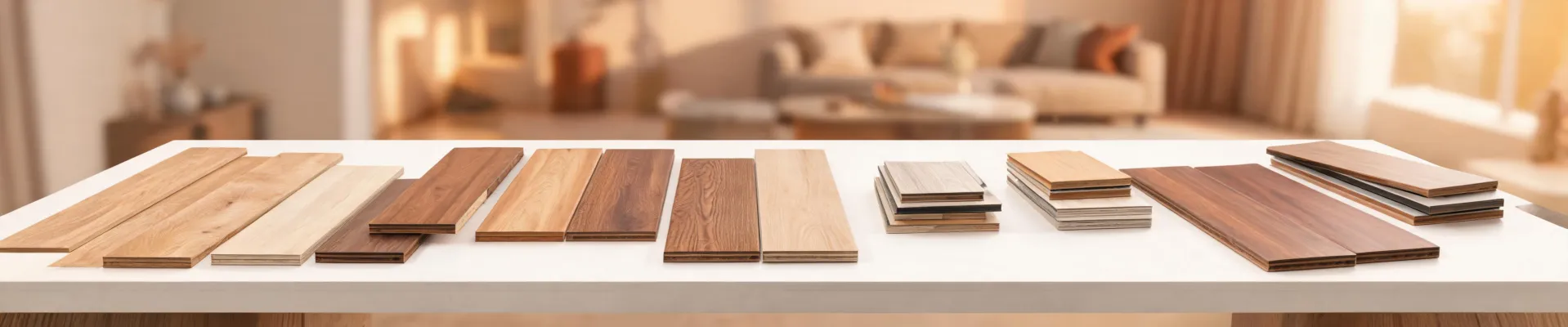
There are two ways to buy bulk commercial flooring. One starts with the lowest per-square-foot price. The other starts with a less popular number: total cost of ownership. I've used both. The first made me look organized. The other taught me how much I didn't know.
I've handled bulk commercial flooring orders for almost nine years. I've specified Shaw flooring in offices, ordered Shaw floors LVP for renovation work, and purchased mosaic tile wholesale for lobbies and feature walls. In that time I've made seven documented mistakes totaling roughly $28,000 in wasted budget. The waste was rarely the product itself. The waste was comparing the wrong things before ordering.
This is not a Shaw vs tile post. It's a comparison between price-first buying and total-cost buying. Keep those two approaches in mind while you read.
Compare What the Quote Actually Contains
The first dimension is line-item transparency. A price-first buyer looks at the product price and maybe a freight line. A total-cost buyer looks at everything that has to happen before the floor is done: subfloor prep, adhesives, transitions, delivery access, installation labor, and future maintenance.
My most memorable mistake happened in 2017. I approved a porcelain tile order because the tile material was cheaper than a Shaw floors LVP alternative. The tile itself was fine. The installation was not. The tile needed a different setting material, the mosaic pattern slowed the work, and the subfloor was not flat enough for the layout we specified. The result was extra labor, extra material, and a one-week delay. I have not forgotten that $890 change order plus the lost week.
Material price is what appears on the quote. Total cost is what appears on the jobsite. Those two numbers can disagree.
I am not a tile installer, so I did not spot all those requirements myself. That was exactly the problem. A good supplier should have made them obvious before I committed. Now I do not compare quotes until every supplier includes the same scope.
What to Look for in a Porcelain Tile Supplier: Color and Lot Control
Here is the blind spot that gets overlooked: samples are not a lot plan. The question everyone asks is can I see a sample? The question I now ask is can I see samples from more than one production lot?
Shaw floors LVP is a manufactured product with pretty strict controls, but it can still have subtle color or embossing shifts between production runs. Tile is fired, glazed, and sorted by lot. Mosaic tile wholesale can be even trickier because a design made of many small pieces can show variation across the room if boxes arrive from different lots.
When I buy mosaic tile wholesale now, I ask the supplier to confirm lot numbers and send multiple samples. For color-critical projects, color tolerance language helps me ask better questions. Pantone color-matching guidelines commonly use Delta E to describe color difference: below 2 is tight, 2 to 4 is visible to trained observers, and above 4 is visible to most people. Porcelain tile does not follow printed-color standards exactly, but it is still a useful reminder that close match is not the same as exact match. It rarely is.
Moisture and Maintenance Claims Need Context
The third dimension is what happens after installation. Price-first buying tends to look for one strong word on a data sheet, like water-resistant or low maintenance. In my experience, those words are starting points, not conclusions.
Tile can be an excellent choice in wet areas, but grout still needs care and the tile still needs a proper substrate. LVP is often faster to install and more forgiving underfoot, but it will not solve a moisture problem that comes from the slab. No flooring product is truly maintenance-free, and I do not think a serious supplier should imply otherwise.
What to look for in a porcelain tile supplier includes real maintenance questions: what does cleaning actually involve, what happens if a tile cracks, and are extra tiles available from the same lot? A supplier who cannot answer those questions before the sale will not be more helpful after the sale.
Support, Claims, and the Boring Test
Fourth, I compare the experience when something goes wrong. A branded product like Shaw flooring usually comes with documented product data sheets and installation instructions. That is one reason I still use it. But those documents are only useful if someone reads them and keeps records.
The test for any supplier is whether they provide lot numbers, product labels, and claim instructions before you ask. For mosaic tile wholesale, that means confirming the boxes on the pallets are actually the lot you approved. Honestly, I'm not sure why some suppliers make that difficult. My best guess is that the ones who are vague about lots also do not keep records after delivery, which tells you exactly who will be responsible if the color does not match.
My Total-Cost Checklist Before Buying Bulk Commercial Flooring
I do not open the price comparison until the checklist is done. That rule came from the mistakes I made in my first few years.
- Does each quote include the full scope: delivery, prep, adhesive, transitions, installation work, and a realistic timeline?
- Can the supplier identify lot numbers and show samples from different lots?
- Does the product have written installation and maintenance guidance that fits this actual building?
- Who handles product damage, shade claims, and warranty paperwork?
- What is the cost of future repairs or replacement, including downtime?
Then I decide by scenario, not by someone's favorite brand. If the schedule is tight and the occupied space needs softer resilience, Shaw floors LVP is usually a lower-total-cost answer in my experience. If the design calls for porcelain tile or mosaic in a moisture-prone area, the wholesale route can make sense only when the tile supplier can answer those five questions. Otherwise, the low unit price becomes a high total cost.
The cheapest quote is not always the most expensive in the end. More often than not, though, an incomplete comparison is. I'd rather pay the real cost upfront than explain the surprise cost later. That's the difference I now care about. The old way is simpler. It is also more expensive, in more ways than money.