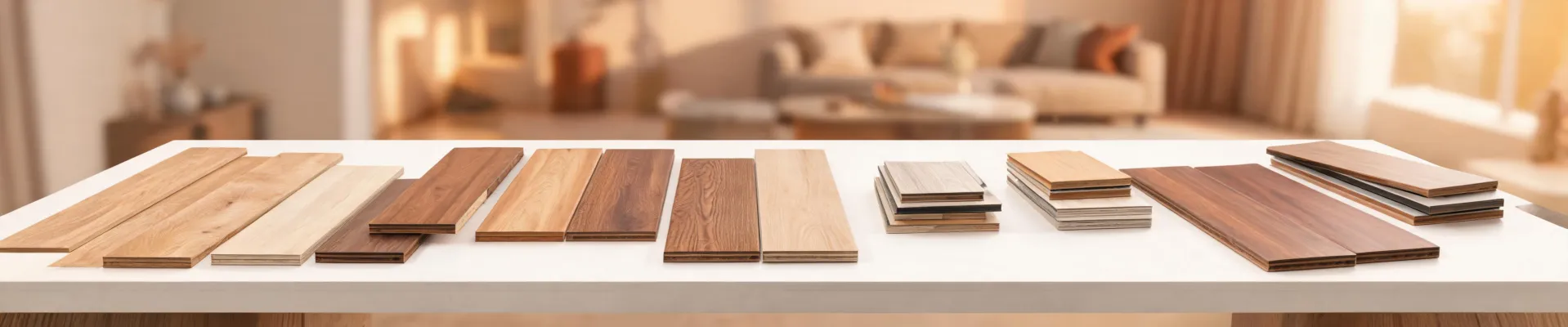
When I first started reviewing material failures, I thought the answer was binary: either the product failed or the installer made a mistake. Several years and a lot of rejected samples later, I think that is usually wrong. The failure is often written into the specification before a single carton reaches the site.
I'm a quality and brand compliance lead at a flooring and building materials manufacturer. I review roughly 200 SKUs a quarter before they go into distributor programs—Shaw flooring, sheet vinyl, tile adhesives, construction sealants, and LVP flooring private label lines. In 2024, I rejected about 17% of first submissions. Most were not rejected because colors were off. They were rejected because the material had been selected without an installation system around it.
The surface problem: everyone suspects the product
The conversation often starts with a complaint. A seam opened in a Shaw sheet vinyl floor. A luxury vinyl plank area feels hollow. A tile installation has bond voids. A sealant joint begins to split. The first assumption is that the manufacturer sent something unacceptable. The second assumption is that a different, more expensive product would have survived.
I understand why people think that. Put two floors side by side in a showroom and the visual quality is obvious. But most problems in my queue are not visible until the product interacts with the substrate, the adhesive, the climate, or the traffic pattern. The symptom is blamed on Shaw sheet vinyl. The cause is elsewhere.
The deeper cause: material choice is treated as enough
Here is the uncomfortable truth I keep returning to: a floor covering is not a standalone component. It is a layer in a system. The system includes substrate flatness and moisture, the correct adhesive, an appropriate sealant, a locking pattern, edge details, acclimation, and cleaning. If you specify the product but not the system, you have not written a specification. You have written a shopping list.
It is tempting to think that compliance paperwork is the same thing as performance. It is not. Construction sealant compliance requirements, for example, are usually described in terms of VOC content and environmental regulations. Those are real requirements. According to California's South Coast Air Quality Management District Rule 1168 (SCAQMD), adhesives and sealants sold in that region must meet specified VOC content limits. But a compliant sealant is still only a material. It also needs a movement class, a substrate compatibility test, and a joint design. A sealant can be legal and completely wrong for a joint that keeps moving.
Tile adhesive sourcing follows the same pattern. Buyers select an adhesive from an approved list, check the VOC certificate, and move on. What gets missed is classification. A tile adhesive can meet indoor air quality requirements and still be unsuitable for a large-format porcelain tile or a floor exposed to moisture. The sourcing question should not be 'what adhesive is approved' but 'what adhesive is approved for this tiling condition.' Those are different questions. Let me rephrase that: approved lists are starting points, not specifications.
The same idea applies to LVP flooring private label. I have reviewed many private-label programs where the blank looked right, the packaging looked right, and the performance documentation did not exist. That does not mean private label is a bad idea. It does mean you are buying a story unless someone writes the technical requirements down. What is the wear layer thickness? What is the core density or flex tolerance? What is the allowable moisture content? What subfloor tolerances does the manufacturer require? If those answers only live in a sales conversation, the quality team will not have anything to verify later.
The real cost of a loose spec
Let me give you a concrete picture. In 2024, I reviewed a 50,000-square-foot sheet vinyl order. The product itself was from a reputable line and met every published tolerance. The issue was the adhesive specified by the general contractor. It had been chosen from a generic category list and was not the adhesive recommended for that backing and seam construction. By the time the seams moved, the distributor had already scheduled the job, the installer had paid the crew, and the owner was asking which brand was responsible. The conversation pointed at the wrong layer of the system.
In another project, an 8,000-unit private-label LVP order was received and warehoused at too low a temperature because no storage condition had been communicated. The product was not defective. It had been exposed to conditions outside the documented spec. The planks had to be reconditioned, inspected, and in some cases replaced. The fix added cost and killed the schedule. If this sounds like a manufacturing fault, it is not. It is a specification fault.
The expensive part is not always product failure. It is the delay, the redistribution, the re-testing, and the blame. I have watched a $22,000 redo happen because nobody verified that the installation gap was compatible with the movement class required on a building expansion joint. The sealant cost difference would have been minor. The cost of replacing it after installation was not.
What actually works: write the system into the order
I have come to believe that most building material complaints could be reduced if procurement and quality review used the same language. The starting point is not the color card. It is the performance scenario. Ask what the space is going to do to the material and choose based on that.
If you are sourcing a Shaw flooring or Shaw sheet vinyl project, the manufacturer's technical literature gives required subfloor tolerances, recommended adhesives, moisture limits, and installation sequences. That literature is not a legal formality. It is the actual performance specification. Use it before you ask for a price. For a private label program, do not accept 'same as the brand sample.' Insist on limits you can verify: plank thickness, wear layer, dimensional tolerance, adhesion values, sound rating, and the lot controls you expect. That makes the product comparable and your vendor accountable.
For tile adhesive sourcing, create a short approved list by substrate and tile type, then link each adhesive to a manufacturer requirement and field test. A certificate of analysis or VOC certificate should arrive with each lot, not after a problem. For construction sealant compliance requirements, separate compliance from performance. Collect the VOC and regulatory record for air quality, but also request the standard the sealant meets for movement, adhesion, and weathering. Both lines should appear on the same submittal.
I still get stopped by people who expect me to name a product that never fails. I do not have one. I have a process that catches system mismatch before it becomes a callback. The product is rarely the only culprit. The spec usually is.